AI assistants are everywhere. There are also many examples of how requirements engineering (RE) can benefit from them. However, for AI services to be used in business, they must meet a number of prerequisites beyond RE, including selection, financing, procurement, training, acceptance, data protection, and IT security.
How well do AI assistants in (RE) fulfil these prerequisites? One indicator of their maturity is the AI functionality available in commercial tools. This article outlines the current state of this area, among other things. In particular, it addresses three topics: (1) Typical AI tool support available to RE practitioners in a corporate environment; (2) Integrated AI functions offered by established RE tools; (3) AI support for RE compared to related areas such as project management and testing.
AI Tool Support for RE in Companies
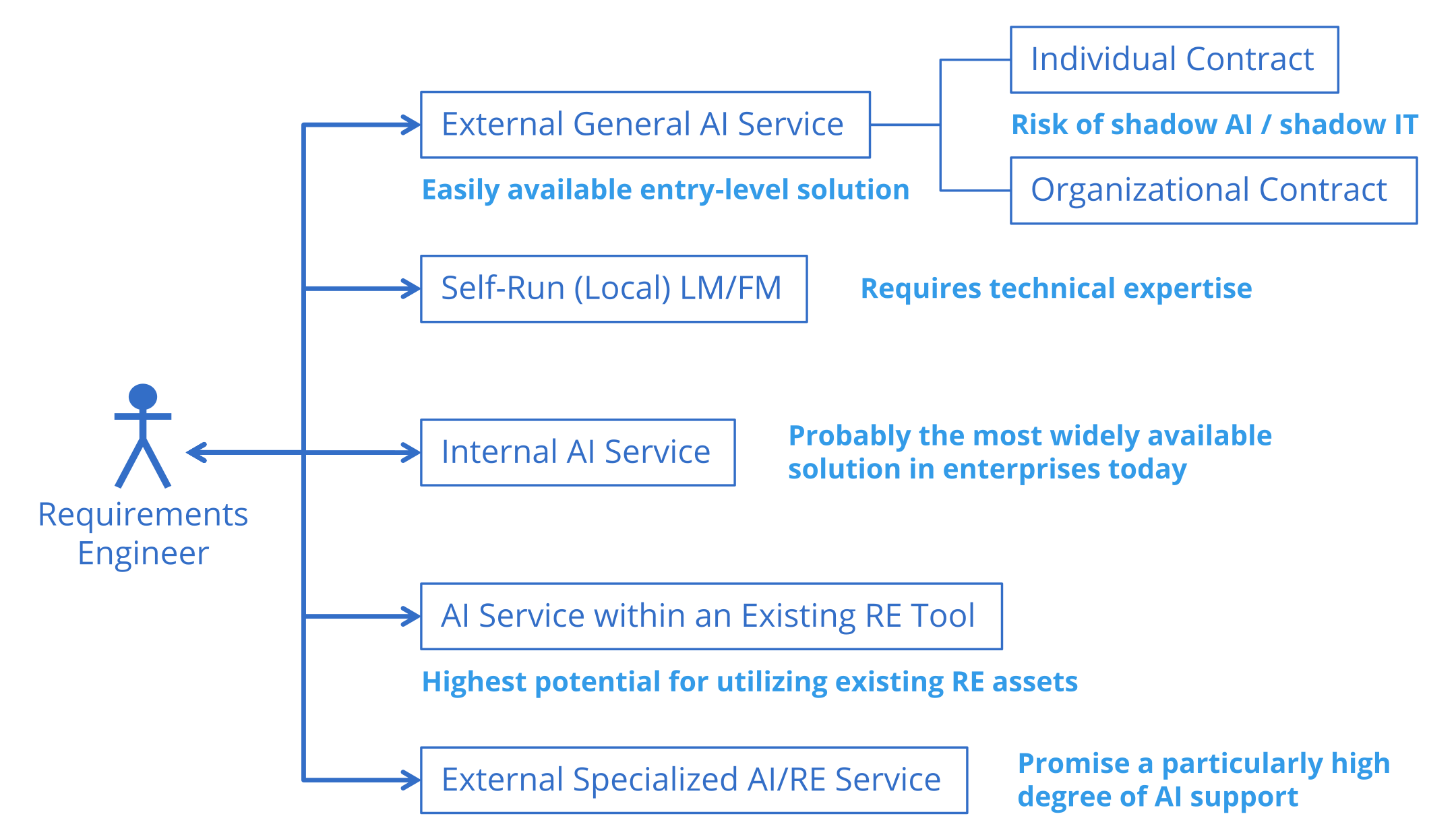
RE professionals can currently use the following types of AI support:
- External General AI Service: AI assistants, chatbots, or agents offered as web services from an external commercial provider; they can be accessed through individual, private contracts or organizational contracts.
- Self-Run (Local) LM/FM: A language or foundation model (LM/FM) that runs on the user’s own infrastructure.
- Internal AI Service: AI assistant or agent provided by the user’s organization, licensed from a commercial vendor or as a custom-developed solution.
- AI Service within an Existing RE Tool: AI feature or add-on product provided by the vendor of an established RE tool.
- External Specialized AI/RE Service: RE tool support developed by a commercial vendor around an AI service.
External general AI services are easily accessible, entry-level solutions. However, they pose a shadow AI/shadow IT risk, particularly through individual user contracts. Self-run LM/FM require technical expertise that few RE users possess. Internal AI services are probably the most widely available in enterprises today. However, they may lack specific RE capabilities and still pose risks to data protection and IT security.
Integrated AI Functions of RE Tools
This section summarizes the results of an investigation into the AI functions offered by 21 well-established RE tools as of November 2025. (For a list of the tools see Appendix A below.) The investigation systematically analyzed the product homepages of the tools to determine the extent to which vendors mention specific AI terms. High emphasis on AI was indicated when the hero section of the webpage featured AI. Medium emphasis was indicated when AI appeared in a feature list or benefits section outside the hero area.
The following table shows the number of tools in each of the three AI emphasis ratings: No mention of AI, Medium, and High.
| No Mention of AI | Medium Emphasis of AI | High Emphasis of AI |
|---|---|---|
| 11 Tools | 6 Tools | 4 Tools |
A bit more than half of the tools did not mention AI at all on their product homepages: Cradle, Accompa, easeRequirements, Kovair, DevOps Server, Dimensions RM, Perforce, Case Complete, Polarion, Innoslate, Visure.
Six tools mentioned AI outside the hero section: DOORS Next, objectiF RM, ModernRequirements, reqSuite rm, Codebeamer, Reqtest. Only four tools highlighted AI at the top of their product homepages: Jira, SpiraTeam, Jama, Core SDP.
Most tools only offer traditional AI, such as natural language processing (NLP) for quality assurance of textual requirements. This has been available in many RE tools for a long time. Only a few tools offer features powered by generative AI, which has driven the current AI wave since ChatGPT's release in November 2022. Notable examples include OpenText and Atlassian solutions.
The investigation revealed a trend toward specialized AI products as add-ons to established RE tools, particularly for advanced solutions. These AI add-on products include: Jama Connect Advisor for Jama Connect; OpenText DevOps Aviator for the OpenText Core Software Delivery Platform; and Atlassian Rovo for Atlassian Jira.
Jama Connect Advisor appears to focus on traditional AI, such as NLP. OpenText DevOps Aviator offered extensive GenAI support as early as November 2023. Atlassian Rovo is currently one of the most advanced solutions. For instance, it provides a semantic model, a multi-LLM strategy, MCP integration (Model Context Protocol), and a high degree of transparency.
AI Support in RE and Related Areas
When comparing the level of AI support in RE tools with that in related areas such as project management and testing, it appears that RE is lagging behind. In the sample of 21 RE tools investigated, 11 still do not feature AI support on their homepages, which is in stark contrast to testing: Established test tool vendors such as OpenText (with the former Micro Focus and HP/HPE portfolio), Tricentis, and Smartesting have marketed GenAI features like the automated creation of test cases since early on (e.g., OpenText since November 2023).
GenAI support has also been offered in project management since late 2023 and early 2024. For example, Atlassian Rovo initially targeted agile project management and issue management. More recently, these AI solutions have included features that make them increasingly relevant to RE applications. As long as most established RE tools continue to use traditional NLP-type AI without providing advanced GenAI support, AI platforms such as Atlassian Rovo and OpenText DevOps Aviator, along with specialized AI/RE solutions such as Storywise, may receive more attention.
Summary and Conclusion
An investigation of AI support in 21 RE tools in November 2025 found that traditional AI techniques, such as NLP, are widely available in RE tools, while GenAI support is still in its early stages.
As a consequence, RE professionals must find ways to link their RE tools with AI services, such as external GenAI assistants (e.g., OpenAI ChatGPT, Google Gemini, Anthropic Claude, and Mistral Le Chat) or company-internal solutions (e.g., adapted Microsoft Copilot or custom solutions). However, these solutions present challenges, such as the difficulty of exploiting semantic models within existing RE assets, countering shadow AI/shadow IT, and ensuring information privacy and security.
The main conclusion is that there is still a gap between the available GenAI support for RE and the needs of enterprise-level RE. One recommended solution is to blend best-of-breed GenAI services with custom solution design. To close the gap with other areas, such as testing and project management, the RE community may pay more attention to the GenAI race.
Appendix A: List of Investigated RE Tools
The following list contains the tools that were part of the investigation. It lists them in alphabetical order by their short names, as they appear in the article. Each entry contains the short name followed by the full name. The underlying link opens a tool’s product homepage in a new browser tab.
Case Complete: Serlio Software Case Complete
Core SDP: OpenText Core Software Delivery Platform
DevOps Server: Microsoft Azure DevOps Server
Dimensions RM: OpenText Dimensions RM
DOORS Next: IBM Engineering Requirements Management DOORS Next
easeRequirements: ease solutions ease requirements for Jira
Innoslate: SPEC Innovations Innoslate
Jama: Jama Software Jama Connect
Kovair: Kovair Software Kovair ALM
ModernRequirements: Modern Requirements ModernRequirements4DevOps
objectiF RM: microTOOL objectiF RM
Perforce: Perforce ALM Requirements Management
Polarion: Siemens Polarion REQUIREMENTS
reqSuite rm: OSSENO reqSuite rm